What a Surface Grinding Machine Trial Should Prove
Use a surface grinding machine trial checklist to find out whether a machine can handle your regular jobs under normal working conditions before you order it. A useful trial covers the part, its setup, the finished result and the time needed. It should leave you with measured results and a clear record of the equipment used.
Watching one easy sample being ground can leave several questions unanswered. Will your largest part fit with its clamps? Can the operator repeat the result? What tools will you need to buy separately? Settle these points while the supplier can show you the answers.
This guide takes you through planning a trial, checking the work and recording what was agreed. It helps workshop owners and purchase teams turn a factory visit into a buying decision based on their own work.
Agree on Pass Limits Before the Machine Demonstration
Begin with the result your customer or repair job requires. Find the correct drawing, repair instructions or approved process sheet. The supplier needs these details before preparing the demonstration.
Write down each feature that matters. This may include a final size, flatness or surface roughness. A tolerance is the allowed difference from the required value. Include the units and explain how each feature will be checked.
Avoid asking for the best possible finish without a clear target. A smooth looking sample may still miss the job requirement. Agree on what counts as a pass before any metal is removed.
Give the supplier time to review the part. If a requirement is outside the proposed machine’s scope, it is better to learn that before arranging travel. Keep the agreed trial plan with the quotation so both teams work from the same document.
Bring Test Parts That Reflect Your Workshop Jobs
Choose samples that represent the work you expect to sell. Include the material, size and starting condition that the machine will normally face. A supplier’s display piece can be useful, but your own parts answer more specific questions.
Prepare this information for each sample:
- Part name, drawing number and revision
- Material grade and known heat treatment
- Overall dimensions and weight
- Starting condition and material available for removal
- Required checks after machining
- Expected number of jobs per day or week
Take enough suitable samples to support the agreed checks. Identify them clearly so the results can be traced to the right piece.
For cylinder heads, confirm repair eligibility and permitted removal before the trial. For general engineering parts, identify the faces that locate the part during machining and inspection. Tell the supplier about thin sections, interrupted surfaces or other features that may affect the setup.
Confirm Which Surface Grinding Machine Is Being Tested
A successful demonstration applies to the equipment and conditions used. Record the machine model and its identity where available. Note the installed drive, controls, tooling and fixture.
Ask whether you are watching a stock demonstration machine or the machine proposed for delivery. Either can provide useful evidence, but the difference should be clear. If the supplied machine will be built later, agree on the checks required before dispatch and after installation.
List every special accessory used during the trial. A result achieved with an optional fixture does not tell you how the basic package will perform without it.
Where milling is demonstrated on a machine also sold for grinding, record that method correctly. Your order should describe the process and supplied tools that produced the accepted sample.
Check Loading Workholding and Full Travel
Watch how the part gets onto the table. Consider its weight, the lifting space and the operator’s access. Include the lifting equipment your workshop would need.
Then look at the supports and clamps. The part should be held using a method suited to its material and shape. Aluminium cannot be held directly by an ordinary magnetic chuck, so it needs appropriate mechanical workholding.
Ask the demonstrator to confirm the complete working path under the approved setup procedure. The tool must reach the required face without striking clamps or running out of usable travel.
Measure space with the fixture fitted. Table length alone does not establish job capacity. Supports consume height, and clamps occupy working space. Note any accessory that makes loading or alignment easier so it can be included in the purchase discussion.
Measure Surface Grinding Machine Results Against the Job
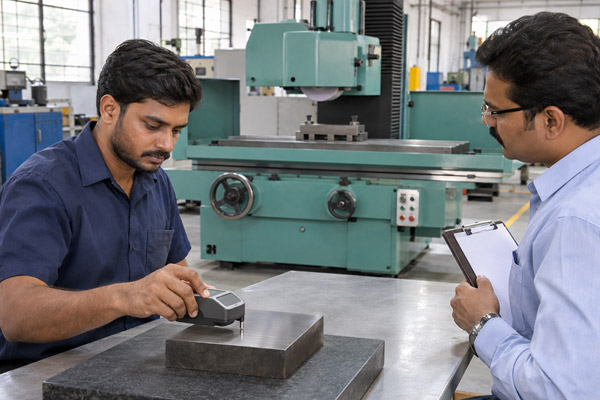
Decide who will inspect the samples and which instruments they will use. Check that the instruments are suitable for the required limits and have a valid calibration status under your quality procedure.
Use the job specification to choose the checks. The table below is a planning guide, rather than a set of universal tolerances.
| Feature | Requirement to record | Evidence to keep |
|---|---|---|
| Final size | Drawing value and allowed variation | Readings at agreed locations |
| Flatness | Applicable limit and measurement method | Inspection report or reading map |
| Parallelism where required | Named reference face and allowed variation | Recorded comparison to that face |
| Surface roughness | Required parameter, value and unit | Tester result with measurement settings |
Flatness describes the shape of one surface. Parallelism compares the orientation of surfaces. Check each only where the job requires it, using an appropriate method.
Surface roughness describes small marks on the face. Ra is one common roughness measure. A roughness result is not a substitute for a flatness check.
Agree on measurement locations and record the roughness tester settings. Clean the part and use the stated inspection conditions. Do not accept a photograph of a shiny face as the whole inspection record.
Check Repeatability After Reloading the Work
Repeatability means getting a similar result when the same process is used again. One good sample gives limited information about that.
Agree on a sensible number of trial parts for your buying decision. Use comparable material and starting conditions. Record every result, including parts that fail. Do not select only the best piece for the report.
Include a reload during the trial where practical. This shows whether the setup can be repeated after a part has been removed. Repeated readings on one finished surface mainly test the measurement process, not the machine’s ability to produce several acceptable jobs.
Let the machine complete its maker’s stated warm up routine. Record any tool change, dressing or adjustment made between samples. These details help explain why results differ and whether the process is practical for your workshop.
Time the Complete Surface Grinding Machine Job
A cutting demonstration may look fast because the sample is already clean, aligned and clamped. Your daily workload includes those tasks.
Ask to time a complete job cycle with clear start and finish points. Use the same definition when comparing different suppliers.
| Stage | Time to record | Frequency to note |
|---|---|---|
| Loading and setup | From ready part to machining start | Each job or batch |
| Machining | All required cutting passes | Each part |
| Tool care | Dressing or tool change time | Actual interval during trial |
| Unloading and inspection | From machining finish to checked part | Each part |
Separate tasks done once per batch from tasks repeated on each part. Record rework too. If a sample needs another pass to meet the requirement, that time belongs in the result.
Use the trial to estimate workflow, with room for normal variation. Do not turn one quick demonstration into a guaranteed daily output figure.
Watch the Controls and Routine Maintenance
Ask the demonstrator to explain the controls while the machine is stopped. Check whether your intended operator can understand normal movement, speed adjustment and stopping procedures after training.
Have the supplier demonstrate the fitted guards and stopping functions under its approved procedure. Nobody should reach near a moving tool to check a finish or remove a sample.
For grinding, ask how the approved wheel or segments are selected and maintained. Dressing restores a wheel’s cutting surface where the process calls for it. The supplier should explain when this is needed and which tools are required.
Review lubrication points, cleaning access and any coolant system fitted. Find out which daily tasks belong to the operator and which need service help. Request the manual and maintenance schedule for the offered
Turn the Trial Report Into Clear Order Requirements
Before leaving, ask for a copy of the completed trial record. It should connect each test piece to its process, inspection result and any remaining issue.
Your record should cover:
- Trial date and people present
- Machine and accessory identification
- Sample details and agreed requirements
- Tooling and operating settings used
- Inspection instruments and results
- Complete job time and adjustments
- Open issues and the agreed next action
Use clear decisions such as accepted, further trial required or unsuitable for this application. If a requirement was not tested, mark it as unverified.
Where a correction is promised, identify who will make it and when the test will be repeated. Keep the accepted configuration in the order documents. Discuss what evidence will confirm that the delivered machine meets the agreed scope.
Record Trial Problems Before Asking for Another Cut
A failed sample is useful when the cause is found and the correction is demonstrated. It becomes a buying concern when the explanation stays vague or the same fault returns.
| Observation | Information to record | Next trial action |
|---|---|---|
| Repeated surface marks | Tool condition and operating settings | Supplier checks the cause and repeats the test |
| Size or shape outside limits | Setup and inspection readings | Confirm the cause before further removal |
| Heat marks or damaged surface | Material and cutting conditions | Review the process and assess the part |
| Results vary between samples | Part order and adjustments made | Repeat comparable jobs after correction |
Surface defects may involve tooling, dressing, support, vibration or cutting conditions. The appearance alone does not prove which item is at fault.
Keep the original result alongside the corrected result. Record what changed. This prevents a purchase decision from depending on an unexplained adjustment that your own operator may struggle to repeat later.
Compare Surface Grinding Machine Price With the Tested Package
After the trial, review the surface grinding machine quotation line by line. Check whether the wheel, cutter, fixture and supports used are included. Confirm any measurement tools you must purchase separately.
Ask for the cost of consumables and common replacement items. Find out whether operator training covers the demonstrated application. Clarify delivery, unloading, installation and commissioning responsibilities before agreeing to the total price.
A practical comparison also includes warranty terms and service access. Ask how a fault is reported, what remote help is available and what a site visit may cost.
Uttam Grinding’s surface grinding machine price page provides related buying information. For your order, use a current quotation that names the exact package tested or agreed for supply.
Arrange a Surface Grinding Machine Trial in Ahmedabad
Uttam Grinding is based in Rakhial, Ahmedabad. Its surface grinding machine range includes the SGM Series and lists grinding and milling capability.
Send your job sheet before requesting a demonstration. Ask about trial availability, sample handling, the proposed configuration and any charges. Confirm these points before bringing parts to the factory.
When choosing a surface grinding machine manufacturer in India, request support details for your own workshop location. Buyers outside Ahmedabad should also discuss freight and installation arrangements. A factory trial and a check after installation serve different stages of the purchase, so agree on the purpose and scope of each.
Conclusion
Use your surface grinding machine trial checklist to answer a purchase question with evidence. Can the proposed setup produce the required work, using a process your team can repeat?
Keep the measured samples, complete job times and agreed accessory list with your quotation. Resolve open issues before placing the order. To discuss a trial with Uttam Grinding, send your application details with the part material, dimensions and required inspection limits.
Frequently Asked Questions
Send the part drawing or repair requirements, material, dimensions, weight and starting condition. Add expected workload and inspection needs. Ask the supplier to confirm the proposed machine and samples required before you arrange the visit.
Yes, suitable parts from your normal work can make the trial more relevant. Agree on their condition and permitted machining first. A simple display sample may help explain the machine, but it cannot answer every question about your application.
There is no single sample count for every purchase. Agree on enough comparable parts to examine repeated results and setup. For demanding work, involve your quality team in planning a more detailed acceptance test.
An Ra reading covers just one part of the trial. Check all features required by the drawing or repair procedure before approval. Record the Ra unit and tester settings, along with the other inspection results.
Ask the supplier to list the differences and explain their effect. Record the proposed delivery configuration separately. Agree on which checks will be repeated on the supplied machine before dispatch or during installation.
Ask before booking. A supplier may offer a demonstration, charge for application testing or apply another arrangement. Get the trial scope, sample costs and any adjustment against the purchase price confirmed in writing.
Keep the readings and request a clear cause review. Ask for the correction and another test under agreed conditions. Leave the requirement open until suitable evidence is available, rather than approving the order on a verbal promise.