Engine Rebuilding Workshop Guide India
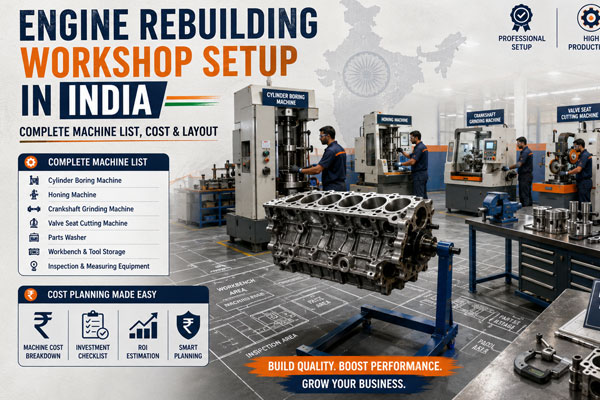
Starting a business in the auto repair sector requires careful planning. An Engine Rebuilding Workshop Setup in India is a smart venture, but it comes with a major challenge: choosing the exact machines, estimating costs, and planning the layout. Many new workshop owners struggle to balance their budget while buying accurate, heavy-duty machinery. Choosing the wrong equipment leads to poor job quality and wasted money.
This guide helps you plan your engine reconditioning workshop setup step by step. You will learn how to choose the best automotive engine rebuilding machines, estimate your investment, and design a smooth workflow. Whether upgrading a garage or building a new diesel repair business, this guide provides the exact machine list, infrastructure needs, and buying advice you need to start successfully.
What Is an Engine Rebuilding Workshop?
An engine rebuilding workshop is a specialised facility where worn or damaged engines are dismantled, cleaned, machined, and assembled to function like new.
Work performed in these workshops includes machining engine blocks, grinding crankshafts, resurfacing cylinder heads, and fitting new parts. These shops handle various engines, including those from passenger cars, heavy-duty trucks, tractors, earth-moving equipment, and industrial generators.
Starting this type of workshop benefits experienced automotive technicians, current garage owners wanting to expand, and new entrepreneurs looking for a steady industrial business.
It is important to know the difference between basic repair, rebuilding, and reconditioning:
| Term | Definition | Goal |
|---|---|---|
| Engine Repair | Fixing a specific broken part (e.g., changing a water pump). | To get the engine running again quickly. |
| Engine Rebuilding | Replacing damaged parts and machining worn components to original specifications. | To restore the engine to a good working condition. |
| Engine Reconditioning | A complete, highly detailed overhaul replacing all wear items and machining everything to factory-level tolerances. | To make the engine perform exactly like a brand-new unit. |
Engine Rebuilding Workshop Setup in India Complete Planning Guide
Planning is the most important step before buying engine rebuilding machines. A poorly planned shop will face electrical issues, slow workflow, and wasted space.
To create a successful engine reconditioning workshop setup, consider the following points:
- Target Customers: Will you serve local mechanics, large transport fleets, or agricultural customers?
- Expected Type and Size of Engines: Decide if you will machine small car engines, heavy diesel truck engines, or massive industrial engines. This dictates the size of your machines.
- Job Capacity: Estimate how many engines you plan to process daily or weekly.
- Machine Selection: Choose heavy-duty automotive engine rebuilding machines that match your engine sizes and job capacity.
- Workshop Space: Ensure you have enough floor area for the machines, material movement, and safe working zones.
- Electrical Load: Calculate the total power needed for all motors, lighting, and air compressors.
- Staff Requirements: You will need skilled machine operators and engine assembly technicians.
- Budget: Plan for machinery, infrastructure, working capital, and unexpected costs.
- Local Approvals: Check municipal and pollution control requirements.
- Installation and Training: Ensure the machine manufacturer will set up the equipment and train your staff.
- After-Sales Support: Always plan for future maintenance and spare parts availability.
Complete Engine Rebuilding Machines List
To build a capable workshop, you need a mix of primary machining equipment and supporting tools. Below is a detailed list dividing the essential engine reconditioning equipment from the optional items.
| Machine Name | Main Purpose | Components Handled | Essential / Optional | Suitable Workshop Type | Important Selection Point |
|---|---|---|---|---|---|
| Crankshaft Grinding Machine | Restoring worn crankshafts | Crankshaft journals and crankpins | Essential | Medium to Advanced | Distance between centers and swing capacity |
| Surface Grinding Machine | Making mating surfaces perfectly flat | Cylinder heads and engine blocks | Essential | All | Table size and grinding head motor power |
| Vertical Cylinder Fine Boring Machine | Enlarging and correcting worn cylinders | Engine blocks | Essential | All | Boring diameter range and spindle accuracy |
| Vertical Cylinder Honing Machine | Creating surface finish for oil retention | Engine block cylinders | Essential | All | Stroke length and spindle speed control |
| Connecting Rod Boring Machine | Machining rod ends accurately | Connecting rods | Essential | Medium to Advanced | Alignment accuracy and clamping system |
| Parts Washing Machine | Removing oil, carbon, and dirt | All engine components | Essential | All | Tank capacity and heating element |
| Air Compressor | Powering pneumatic tools and cleaning | General workshop use | Essential | All | Tank volume and air pressure (CFM) |
| Hydraulic Press | Pressing bearings and pins | Various components | Essential | All | Tonnage capacity (e.g., 20 or 50 tons) |
| Measuring Instruments | Inspecting machining tolerance | All machined parts | Essential | All | Quality brands for micrometers and bore gauges |
| Valve-Seat & Grinding Tools | Restoring valve seats | Cylinder heads | Optional (Expansion) | Medium to Advanced | Accuracy and angle adjustments |
| Crankshaft Polisher | Final polishing of journals | Crankshafts | Optional (Expansion) | Advanced | Belt quality and ease of use |
| Pressure-Testing Equipment | Checking for internal cracks | Cylinder heads and blocks | Optional (Expansion) | Advanced | Heating capacity and pressure range |
Important:
Always clearly separate essential machines from expansion-stage equipment to manage your initial budget properly.
Crankshaft Grinding Machine for an Engine Rebuilding Workshop
A crankshaft is the heart of an engine. Over time, the crankshaft journals and crankpins suffer from wear and tear. A crankshaft grinding machine restores these worn surfaces to their correct, round dimensions so new bearings can be fitted.
Typical applications include grinding crankshafts for cars, tractors, and heavy diesel trucks. When buying this machine, you must check the “distance between centers” (which dictates the maximum length of the crankshaft) and the “swing over bed” (which dictates the maximum diameter).
A common buyer mistake is purchasing a machine that is too small for heavy diesel engine crankshafts. Because crankshaft grinding is a high-demand service, this machine contributes significantly to a workshop’s revenue. Any medium-to-large workshop dealing with complete engine overhauls must have one.
For accurate and heavy-duty performance, explore the crankshaft grinding machine specifications offered by Uttam Grinding.
Surface Grinding Machine for Cylinder Head and Engine Block Work
If the surface of a cylinder head or engine block is not perfectly flat, the engine will suffer from blown head gaskets and coolant leaks. A surface grinding machine performs cylinder-head resurfacing and engine-block resurfacing to restore this flatness.
This machine offers grinding and milling capabilities to achieve the exact surface finish requirements needed for modern engines. It commonly handles materials like cast iron and aluminium.
When selecting this machine, important considerations include the table size (it must be long enough for big engine blocks) and motor power. A common problem in resurfacing is a poor finish caused by vibrations; this is solved by choosing a machine with a heavy, rigid cast-iron base.
To find a machine that guarantees a leak-proof finish, review the surface grinding machine from Uttam Grinding.
Vertical Cylinder Fine Boring Machine
As an engine runs, its pistons move up and down, eventually wearing out the cylinder walls. The cylinder boring process removes this wear by cutting a precise amount of metal from the inside of the cylinder.
Correct bore size and alignment matter greatly. If the bore is crooked or the wrong size, the engine will burn oil or fail completely. You must select a machine capacity that matches the largest engine block you plan to service. The operator must also calculate the correct “boring allowance”—leaving just enough metal for the final honing process.
A common error is boring cylinders without properly clamping the engine block, leading to oval-shaped holes. A workshop should purchase this machine on day one, as it is a core service.
Learn more about high-precision boring by checking the vertical cylinder fine boring machine.
Vertical Cylinder Honing Machine
Boring a cylinder leaves a rough surface. Honing is performed after boring to create the final size and a specific surface finish known as a “cross-hatch pattern.”
This cross-hatch pattern is vital for oil retention. It holds a microscopic layer of engine oil on the cylinder wall to lubricate the piston rings. Without proper honing, the engine will overheat and fail.
A good machine allows the operator to adjust the spindle speed and feed rate to get the perfect pattern. Common honing problems include glazing the cylinder wall or creating the wrong cross-hatch angle. Selecting a machine with a sturdy spindle and smooth hydraulic feed prevents these issues.
Discover durable honing solutions by exploring the vertical cylinder honing machine page.
Connecting Rod Boring Machine
Connecting rods link the pistons to the crankshaft. The big-end and small-end of the rod often become distorted under extreme engine pressure. A connecting rod boring machine machines these ends back to perfect circles.
Bore accuracy and alignment are critical here. If the connecting-rod bore is even slightly misaligned, the piston will scrape the cylinder wall. Typical workshop applications involve boring rods for heavy-duty trucks and tractors, where rod failure is common.
Important machine-selection points include a highly accurate clamping system and a vibration-free spindle. A common problem is poor clamping, which results in crooked bores; a high-quality machine solves this with precision-machined fixtures.
To handle rod reconditioning properly, look at the reliable connecting rod boring machine designed by experts.
Engine Rebuilding Workshop Cost in India
Planning your engine rebuilding workshop cost in India requires a realistic view of machine prices, infrastructure, and working capital.
Note:
All prices and setup costs are indicative and approximate. Costs depend on capacity, automation, accessories, taxes, transport, installation, and customisation.
Table 1: Approximate Machine and Equipment Cost Categories
| Cost Category | Included Items | Estimated Cost Range (Indicative) |
|---|---|---|
| Major Machines | Boring, Honing, Surface Grinding, Crankshaft Grinding | Contact the manufacturer for the latest quotation |
| Supporting Equipment | Parts washer, air compressor, hydraulic press | ₹1,50,000 – ₹4,00,000 |
| Measuring Tools | Micrometers, dial bore gauges, straight edges | ₹50,000 – ₹1,50,000 |
| Infrastructure Setup | Machine foundation, electrical wiring, heavy lighting | ₹1,00,000 – ₹3,00,000 |
| Logistics & Setup | Transport, installation, operator training | ₹50,000 – ₹1,50,000 |
| Safety & Handling | Hoists, lifting chains, fire safety, safety gear | ₹75,000 – ₹2,00,000 |
| Working Capital | Rent, staff salary, electricity bills (first 3-6 months) | ₹3,00,000 – ₹6,00,000 |
Table 2: Workshop Setup Levels
| Feature | Basic Workshop | Medium-Capacity Workshop | Advanced Workshop |
|---|---|---|---|
| Suitable Business | Local garage support, small cars, bikes | Tractors, cars, light commercial vehicles | Heavy diesel trucks, industrial engines |
| Approximate Space | 500 – 800 sq. ft. | 1,000 – 1,500 sq. ft. | 2,000+ sq. ft. |
| Machines Included | Boring machine, small surface grinder | Boring, Honing, Surface Grinder, small Crank Grinder | All heavy-duty machines, testing equipment |
| Staff Requirement | 2 – 3 Workers | 4 – 6 Workers | 8+ Workers |
| Expected Job Capacity | 1 – 2 engines/day | 3 – 5 engines/day | 5+ heavy engines/day |
| Approximate Investment | ₹10 Lakhs – ₹18 Lakhs | ₹20 Lakhs – ₹40 Lakhs | ₹50 Lakhs+ |
Always confirm exact figures and technical requirements with the machine supplier before budgeting.
Engine Rebuilding Workshop Layout and Workflow
An efficient automotive machine shop layout prevents bottlenecks. You want parts to flow naturally from arrival to dispatch without crossing back and forth.
Vehicle or engine receiving → Dismantling → Parts washing → Inspection and measurement → Crankshaft machining / Cylinder boring & honing / Surface grinding / Connecting-rod work → Cleaning after machining → Assembly → Testing → Dispatch
Layout Planning Table
| Workshop Zone | Main Work | Equipment Required | Safety Requirement | Recommended Placement |
|---|---|---|---|---|
| Receiving/Dismantling | Opening engines | Hand tools, hoist | Oil spill control | Near the entrance door |
| Cleaning Area | Removing dirt/carbon | Parts washing machine | Ventilation | Isolated from clean areas |
| Heavy Machining | Boring, Grinding, Honing | Main rebuilding machines | Eye protection, ear guards | Center of shop on strong foundations |
| Inspection & Assembly | Measuring and building | Micrometers, clean tables | Extreme cleanliness | Far away from grinding dust |
| Testing & Dispatch | Checking final product | Testing tools, pallets | Fire safety | Near the exit door |
Important:
You must separate dirty work (like washing) and grinding work from the assembly area. Grinding dust can ruin a freshly assembled engine.
Space Utility and Infrastructure Requirements
A machine is only as good as the infrastructure supporting it. Never place heavy machines on thin floors.
| Infrastructure Item | Requirement |
|---|---|
| Approximate Floor Space | Depends on setup (500 to 2,000+ sq. ft.). Plan wide walkways. |
| Machine Foundation | Heavy concrete pads to absorb vibrations. Confirm exact specs with manufacturer. |
| Electrical Power | 3-phase industrial power supply. Calculate total load with the manufacturer. |
| Air Supply | High-pressure pneumatic lines routed securely along the walls. |
| Lighting | Bright, shadow-free LED lights directly above machining and inspection areas. |
| Ventilation | Exhaust fans to remove chemical fumes, heat, and metal dust. |
| Coolant Handling | Coolant filtration system to recycle cutting fluids and save money. |
| Drainage | Floor drains with oil-catchers in the washing zone. |
| Material Movement | Overhead gantry crane or strong engine hoists for lifting heavy blocks. |
| Storage | Heavy-duty racks for customer parts to prevent mixing up engine components. |
Important:
Always confirm machine foundation, electrical load, lifting capacity, and utility requirements with the equipment manufacturer before installation.
Staff Skills and Training Requirements
Machines do not run themselves. The success of an engine reconditioning workshop setup depends entirely on your team.
- Machine Operator: Must understand machining tolerance, speeds, feeds, and how to read measuring tools.
- Engine Technician: Specialises in dismantling and building engines correctly.
- Quality Inspector: Double-checks all measurements using dial bore gauges and micrometers before assembly.
- Helper: Assists with lifting, moving, and cleaning parts.
- Workshop Supervisor: Manages the workflow and communicates with customers.
You must provide basic safety training (using guards and glasses), measuring-instrument training, and preventive-maintenance training (cleaning and oiling machines daily).
Licences and Registrations for an Engine Rebuilding Workshop in India
Operating legally is vital. While requirements vary by state, city, workshop size, and activity, you generally need the following:
- Business Registration: Registering as a Proprietorship, Partnership, or Pvt Ltd company.
- GST Registration: Required for invoicing customers and claiming tax credits on machine purchases.
- Udyam Registration: MSME registration for possible government subsidies and bank loans.
- Shop and Establishment Registration: A basic local municipal requirement for commercial shops.
- Pollution Control Requirements: Certificates regarding noise limits and safe waste-oil and coolant disposal.
- Fire-Safety Compliance: Necessary for obtaining local trade licences.
State clearly: Advise a local consultant or municipal authority to confirm exact rules for your specific area.
Common Engine Rebuilding Workshop Setup Problems and Solutions
| Problem | Solution |
|---|---|
| Buying undersized machines | Plan for the future; buy machines that can handle the largest engine in your market. |
| Poor workflow | Design a shop layout where parts move in a straight line from dirty to clean areas. |
| Inadequate power supply | Consult an electrician to install a dedicated 3-phase line with proper MCB protection. |
| Incorrect machine foundation | Follow the machine manufacturer’s exact concrete depth and leveling instructions. |
| Lack of measuring tools | Invest in high-quality micrometers and dial gauges; accuracy is your main product. |
| Poor coolant management | Use a proper coolant filtration system to prevent bad smells and rust on machines. |
| Untrained operators | Demand operator training from the machine manufacturer during installation. |
| Mixing dirty and clean areas | Build physical partitions or walls between the washing station and the assembly room. |
| Buying only on price | Look at total value, accuracy, and machine weight. Cheap, light machines vibrate and fail. |
| Ignoring after-sales support | Buy directly from an established Indian manufacturer with a strong service network. |
How to Select an Engine Rebuilding Machine Manufacturer in India
Choosing an engine rebuilding machine manufacturer in India is your biggest decision. Use this checklist:
- Manufacturing experience: How long have they been making machines?
- Machine construction: Are they using heavy-duty cast iron to prevent vibrations?
- Available capacities: Do they have machines for small cars and huge industrial engines?
- Accuracy: Do they guarantee spindle and bed precision?
- Product demonstration: Will they show you the machine running?
- Customisation: Can they adjust features based on your needs?
- Installation: Do they send engineers to install the machine at your workshop?
- Operator training: Will they teach your staff how to use the equipment safely?
- Warranty: Is there a clear, written warranty policy?
- Spare parts: Are spare parts and grinding wheels easily available?
- Customer references: Can you speak to other workshop owners using their machines?
How to Estimate Workshop ROI and Payback
Before starting, estimate your Return on Investment (ROI). Use this simple calculation logic:
Simple Formula:Monthly Profit = Total Monthly Revenue – Total Monthly Expenses
Example Logic:
- Monthly Jobs: 30 engines.
- Average Revenue per Job: ₹15,000 (Total: ₹4,50,000).
- Operating Cost: Electricity (₹20,000), Consumables (₹30,000).
- Staff Cost: ₹80,000.
- Loan Payment / EMI: ₹70,000.
- Total Expenses: ₹2,00,000.
- Approximate Monthly Profit: ₹2,50,000.
By comparing your monthly profit against your initial investment, you can estimate how many months it will take to recover your costs. Do not assume guaranteed earnings; actual profit depends on your local market, pricing, and job volume.
New vs Used Engine Rebuilding Machines
Many new owners wonder if they should save money by buying used machinery. Here is a realistic comparison:
| Feature | New Engine Rebuilding Machines | Used Engine Rebuilding Machines |
|---|---|---|
| Purchase Price | Higher initial cost. | Lower initial cost. |
| Warranty | Full manufacturer warranty. | Rarely any guarantee. |
| Accuracy | Factory-perfect machining tolerance. | Worn beds and spindles reduce accuracy. |
| Maintenance | Low maintenance in early years. | High risk of sudden breakdowns. |
| Spare Parts | Easily available from the manufacturer. | Hard to find for older, obsolete models. |
| Installation Support | Provided by the manufacturer. | Usually not included. |
| Suitable Buyer | Workshops wanting reliability and high output. | Hobbyists or mechanics with very tight budgets. |
Key Takeaway:
A new machine is a long-term investment in quality. Used machines often cost more in the long run due to lost jobs and constant repair bills.
Conclusion
Setting up an engine rebuilding workshop in India is a highly rewarding business if planned correctly. The key to success lies in choosing the right space, calculating your electrical and financial needs realistically, and investing in heavy-duty machinery.
Whether you are performing basic cylinder boring or complete heavy diesel engine overhauls, the quality of your machines dictates the quality of your work. Always prioritise accuracy, robust cast-iron construction, and strong after-sales support over cheap prices.
Ready to build a reliable and profitable workshop? Contact Uttam Grinding today for expert machine selection advice, detailed specifications, and a customised quotation for your new business.
FAQs
The cost to set up an engine rebuilding workshop in India varies widely. A basic setup may require an indicative investment of ₹10 Lakhs to ₹18 Lakhs. A medium or advanced setup handling heavy engines can range from ₹20 Lakhs to over ₹50 Lakhs. Contact machine manufacturers for accurate quotations.
Essential engine rebuilding machines include a crankshaft grinding machine, surface grinding machine, vertical cylinder fine boring machine, vertical cylinder honing machine, and a connecting rod boring machine. You will also need an air compressor, parts washing machine, and precise measuring instruments.
Space requirements depend on the workshop size. A basic shop needs 500 to 800 square feet. A medium setup requires 1,000 to 1,500 square feet. An advanced heavy-duty engine workshop needs 2,000+ square feet to safely accommodate heavy machines, engine dismantling, and assembly zones.
Yes, many business owners start small. You can begin with a cylinder boring machine and a surface grinding machine to handle basic block work. As your revenue grows, you can expand by adding a crankshaft grinding machine and a connecting rod boring machine.
Cylinder boring uses a cutting tool to remove heavy metal and resize a worn engine cylinder to a larger diameter. Honing is done after boring; it uses abrasive stones to create a smooth surface finish and a cross-hatch pattern, which helps retain engine oil.
A crankshaft grinding machine is used to repair worn crankshafts. It grinds the main journals and crankpins back to a perfectly round shape and a specific size, allowing technicians to install new bearings and restore the engine’s performance.
Yes, heavy-duty engine rebuilding machines require a strong, level concrete foundation. This absorbs vibrations during heavy cutting, ensuring high machining tolerance and accuracy. Always ask the machine manufacturer for the exact foundation depth and layout drawing.
A small workshop can operate with 2 to 3 workers, including a machinist and a helper. A medium to large setup handling multiple engines daily requires 4 to 8 workers, including dedicated machine operators, engine assembly technicians, quality inspectors, and helpers.
Yes, operator training is completely necessary. Machining engine parts requires an understanding of precise tolerances, feeds, speeds, and measuring tools. An untrained operator can ruin an expensive engine block. Always request training from the machine manufacturer.
Buying new engine rebuilding machines is highly recommended. New machines offer factory accuracy, warranties, operator training, and spare parts support. Used machines may cost less initially but often suffer from worn beds and spindles, causing poor accuracy and frequent breakdowns.
You can request a customised machine by speaking directly with an engine rebuilding machine manufacturer in India. Explain your specific needs, such as a larger table size, specific motor power, or different spindle speeds, and they will build it to your requirements.
Planning and executing a workshop setup usually takes 2 to 4 months. This time is needed to secure financing, prepare the workshop space, pour concrete foundations, install electrical wiring, wait for machine delivery, and complete the installation and staff training.