Advanced Rod Boring Machines in Engine Manufacturing
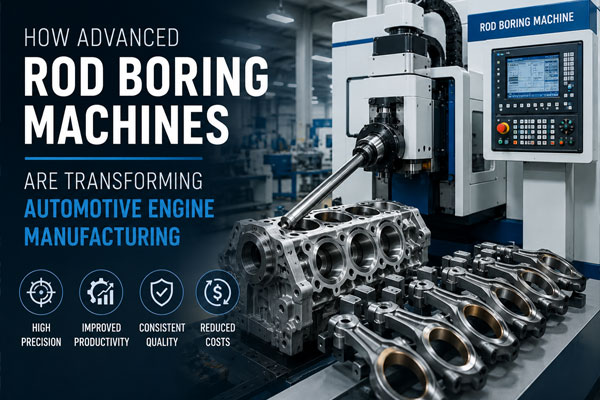
In today’s automotive industry, precision and efficiency are more critical than ever. Every engine component must meet exact specifications to ensure performance, durability, and fuel efficiency. One of the most critical processes in engine manufacturing is the boring of connecting rods, and advanced connecting rod boring machines are transforming how this is done.
These machines ensure micron-level accuracy, reduce rework, and allow manufacturers to produce engines that are highly reliable and performance-optimized. In this blog, we’ll explore how advanced rod boring machines are reshaping automotive engine manufacturing, their advantages, applications, and key considerations.
What Is a Connecting Rod Boring Machine?
A connecting rod boring machine is a specialized piece of equipment used to bore, align, and finish the holes in connecting rods of internal combustion engines. Properly bored connecting rods are essential for:
- Maintaining perfect alignment with the crankshaft
- Ensuring smooth piston movement
- Reducing wear and engine vibrations
Modern machines come equipped with CNC controls, digital measurement systems, and high-precision boring tools, allowing for consistent and repeatable results.
Advantages of Advanced Rod Boring Machines
Applications in Automotive Engine Manufacturing
Automobile Engines
- Passenger cars, commercial vehicles, and high-performance sports cars.
Motorcycles
- Ensures smooth and efficient engine operation in two-wheelers.
Industrial Engines
- Diesel generators, pumps, and heavy machinery engines.
Performance Tuning & Rebuilding
- Aftermarket and racing engines rely on precision rod boring for maximum efficiency.
Types of Rod Boring Machines
| Type | Features | Applications |
|---|---|---|
| Manual Rod Boring Machines | Operator-controlled, suitable for small workshops | Repair work and prototype engines |
| Semi-Automatic Rod Boring Machines | Partially automated with adjustable settings | Medium-scale engine production |
| CNC Rod Boring Machines | Fully automated, high precision and digital measurement | Mass production and high-performance engines |
How Rod Boring Machines Work
- Mounting the Connecting Rod: Rods are securely clamped in the machine.
- Alignment: Machines align the rod bore perfectly with the crankshaft axis.
- Boring Process: Rotating cutters or boring bars enlarge or finish the hole to precise specifications.
- Measurement & Verification: Digital readouts or probes measure diameter and concentricity.
- Final Finishing: Machines can also perform deburring and polishing for smooth surfaces.
Modern CNC machines combine these steps, reducing human error and production time.
Maintenance and Best Practices
- Regular Calibration: Ensures accuracy of boring tools and digital readouts.
- Lubrication: Keep cutting and rotating parts properly lubricated to avoid wear.
- Tool Inspection: Check boring bars and cutters for sharpness and integrity.
- Clean Workspace: Remove metal shavings and dust to prevent defects.
- Operator Training: Ensure skilled operators for semi-automatic machines.
Advantages Over Traditional Methods
| Feature | Advanced Rod Boring Machine | Traditional Manual Boring |
|---|---|---|
| Precision | Micron-level | Less consistent |
| Production Speed | High | Low |
| Rework Rate | Minimal | Higher |
| Flexibility | Adjustable for multiple engine types | Limited |
| Quality Assurance | Integrated digital checks | Manual inspection |
Observation: Advanced rod boring machines maximize accuracy, reduce defects and increase production efficiency,
making them more reliable than traditional manual boring methods.
Observation: Surface grinding machines outperform traditional methods in precision, efficiency, and repeatability.
FAQs About Connecting Rod Boring Machines
Accurate rod boring ensures proper alignment with the crankshaft, reduces friction, and prevents engine failure.
Yes, CNC rod boring machines are capable of handling high-performance and racing engine rods.
Calibration is recommended weekly or after significant production runs to maintain micron-level accuracy.
CNC machines are ideal for medium to large-scale production; small workshops may use manual or semi-automatic machines.
Typically aluminum, steel, and alloy rods used in automotive engines.
Conclusion
Advanced connecting rod boring machines are transforming automotive engine manufacturing by delivering precision, efficiency, and consistency. They reduce rework, increase production speed, and ensure high-performance engines that meet modern standards.
Whether in automotive assembly lines, performance tuning workshops, or industrial engine manufacturing, these machines are indispensable for engineers aiming for micron-level accuracy and reliable engine performance.